Good Food Governance
Finding the perfect match: the new service pairing farmers and landowners
By Hannah Shepherd
Good Food Governance
By Hannah Shepherd

In January 2026, a new service called Landmatch England will launch with the aim of connecting land-seeking agroecological farmers and landowners, with a strong focus on long-term relationship building. Volunteer Hannah Shepherd spoke to Landmatch England’s south-west coordinator Hannah Padgett to find out more.
Attracting new, innovative farmers is critical for England’s food security and the resilience of local economies. Yet prohibitive land prices and a lack of accessible support services create significant barriers for those hoping to join the industry. At the same time, momentum is building among farmers seeking regenerative, agroecological methods that aim to restore soil health and biodiversity. Could a land matching service provide a much-needed win-win for both land seekers and landowners?

Unlike Wales and Scotland, England does not have its own government-funded, centralised land matching service. To bridge this gap, four ambitious organisations – the Community Supported Agriculture (CSA) Network UK, Shared Assets CIC, Tamar Grow Local CIC and the Landworkers’ Alliance (LWA) – have come together to develop Landmatch England and connect land seekers with landowners.
A 2024-2025 review of the Scottish Land Matching Service found that building successful matches was a slow process, and that personal chemistry between the partners is key. “We’re conscious of how labour-intensive it is to build the trust between the landowner and land seeker,” Landmatch England’s South West coordinator Hannah Padgett told me. She explained that they have learnt a lot from the other schemes, in particular that “having a regional coordinator who can tap into local organisations and networks is really important.’
“What’s been interesting about the land offers is that they involve a lot of enterprise stacking”. Enterprise stacking is a farming model that layers interconnected farming activities on the same land. Hannah describes an example of a National Trust property that is interested in working with market garden enterprises because the area was historically renowned for their market gardens. “[Landowners] are keen to be really open.”
Land matching initiatives not only contribute to more locally rooted food production but to more creative models of growing food. “[Partners] can share routes to market and create their own Community Interest Companies and by doing so [landowners] are creating their own hub through a group of producers on their land.”
Hannah and Cordelia, her North West regional counterpart, will be spending a lot of their time supporting land seekers to develop their business plans. Regional coordinators will be on hand to give feedback, read drafts and get plans to a stage where the landowner is confident in the commitment level of the land seeker.
Hannah described how one of the couples involved in the South West pilot have been looking for a landowner since 2023, despite their long-standing experience on Community Supported Agriculture farms. “Landmatch England will help them create something much more secure… The negotiation process is extremely important,” says Hannah. With a robust plan in place, their application is more likely to be successful.

From podcasts offering legal guidance to Landmatch England’s financial projection templates, the website provides a rich resource library designed to support knowledge sharing. The team has even been working with a land agent to develop guidance on agreements that promote greater transparency.
Partnering with the Pathways to Land project, Landmatch England will also offer a year-long support package for marginalised farmers who are BPOC (Black People and People of Colour) or from economically disadvantaged backgrounds, complete with farm trips and focused knowledge exchange sessions.
“My favourite thing about the Landmatch England service is that moment, after I have recorded all these very bespoke needs from a landowner or land seeker, when I can clearly see the potential for a really great match” says Hannah. “Often these people have been looking for a really long time and it’s so great to be able to make it happen for them.”
Eager to know more? Attend the Landmatch England online webinar launch on Wednesday 21 January or the in-person workshop “The Great Lunchtime Landmatch — For Growers And Landholders” at Oxford Real Farming Conference on Thursday 8 January at 12.30 in the Blue Boar House.
Visit the website at www.landmatchengland.org.uk
To stay updated on future events, job opportunities and news, don’t forget to sign up for the Bristol Good Food Update at bristolgoodfood.org/newsletter.
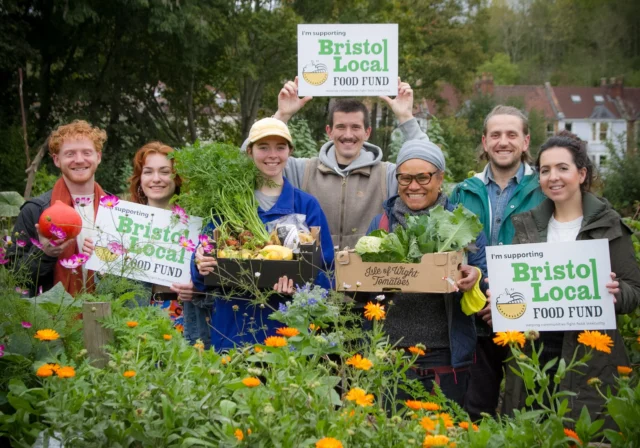
Photo credits: lead image by Herbfarmacy and beetroot and goat photos by Bristol Food Producers.
So, what change do you want to see happen that will transform food in Bristol by 2030? Do you already have an idea for how Bristol can make this happen? Join the conversation now.
* Required field